
AI OPTIMIZATION FOR HOTELS: THE NEW RACE FOR INFLUENCE AND BOOKINGS
Journal / Hospitality & Travel / 12.12.25
The Future of Hotel Competition Has Already Begun
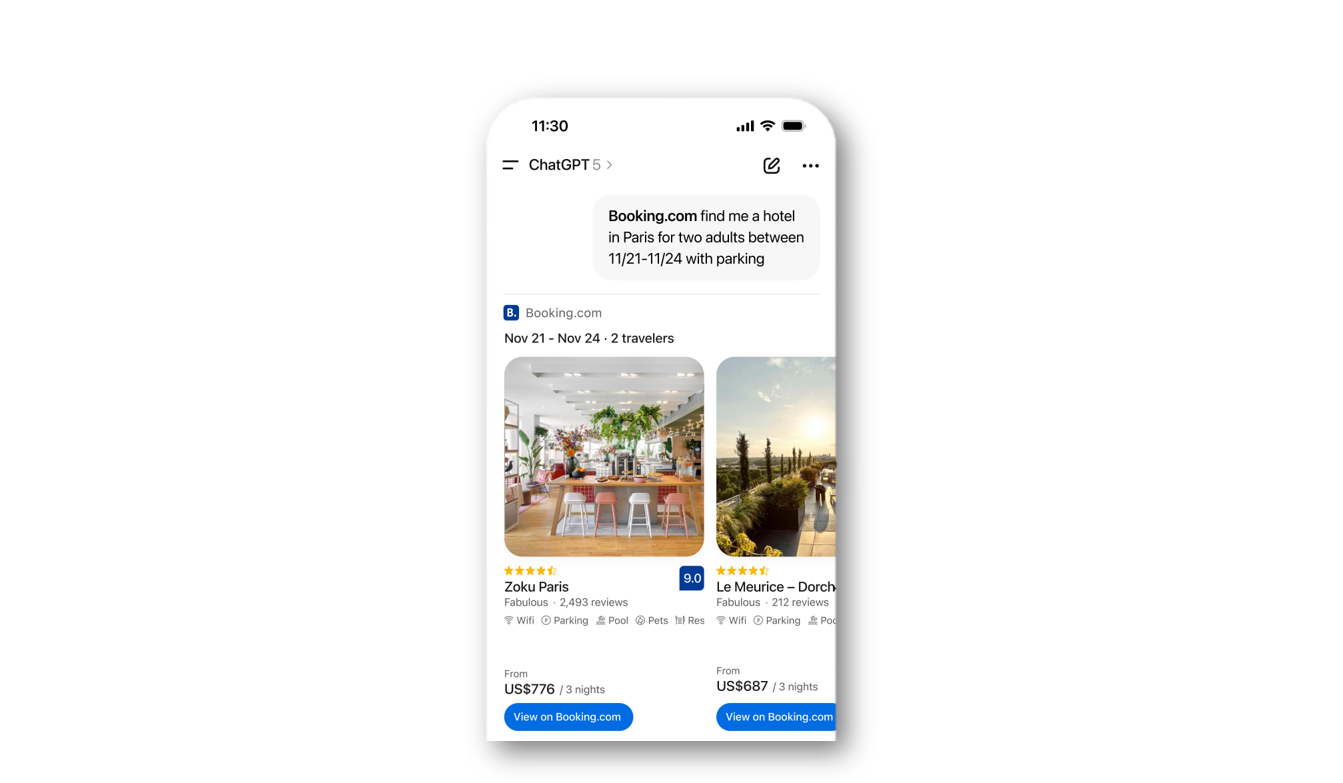
Imagine this: a guest opens ChatGPT and types, “Booking, find me a hotel in Paris with parking”
The answer doesn’t come from Google it comes from Booking.com, which is now fully integrated into ChatGPT. The guest never searches again, never sees your website, and never compares prices. This specific booking happens instantly, inside the chat.
This moment is a wake-up call: the conversation that decides where travelers stay is already happening and if your hotel isn’t part of it, you’re losing revenue before you even know the guest was looking.
Every few decades, an industry quietly changes forever. For hospitality, that shift is happening now, and it’s invisible to the eye. The next booking battle won’t be fought on search rankings or glossy ads, but inside AI systems deciding which hotel deserves to be recommended. When a traveler asks Google, ChatGPT, Gemini, or Perplexity, “Where should I stay?”, the algorithm answers once. One property wins attention, trust, and revenue. The rest disappear from the conversation. For hotel owners and general managers, this is not about marketing, it’s about survival in the new distribution game.
What the rise of AI means for hotel visibility and bookings
The digital travel landscape is transforming. Old SEO tactics focused on keyword rankings and top links are losing power. Today, AI engines like Google’s AI Overviews dominate the traveler’s decision journey, summarizing hotel options and providing quick answers. Over 50% of hotel-related searches already include AI-generated summaries that take up nearly half the mobile screen.
Industry research shows that as AI-powered summaries take over search results, organic traffic declines by up to 43% in the hospitality sector. At the same time the quality of visitors increases dramatically as these guests are more likely to book because they’ve already completed their research. Meanwhile, platforms such as ChatGPT, Google AI Mode and Perplexity are becoming digital travel advisors trusted by millions.
This shift demands focus on AI Optimization for Hotels (AIO), also known as LLM SEO, GEO (Generative Engine Optimization), or Answer Engine Optimization. The goal: ensure your hotel becomes the reliable, credible name AI chooses to recommend. Those who delay risk becoming invisible; those who adapt first will shape how guests discover travel.
Why AI visibility is quietly redefining market leadership in hospitality
The future of hotel success lies in AI citations, how often your hotel is mentioned or recommended by AI platforms. Being included in these AI-generated answers signals credibility and creates awareness even before a user clicks.
Imagine a traveler asking, “Which hotel is the best choice near the Acropolis?” AI responds with one trusted answer. The properties consistently cited in these responses will control demand, and pricing power.
In a 2025 study, 55% of all citations feeding AI-recommendations in hospitality were from OTAs, but only about 6% were from hotel websites. The Hotels that will invest in clear,
structured, and trustworthy on-site information will increasingly be the ones that AI chooses to recommend.
Winning hotels are no longer just search competitors, they’re trusted hosts recognized by both guests and algorithms.
How to position your hotel as the obvious choice in AI search results
Travelers now seek instant confidence, not long comparison lists. AI-powered tools like ChatGPT and Google AI Overviews process massive data and present one or two standout choices.
Your hotel’s online story should do more than list amenities. It needs to demonstrate credibility and expertise, showing that your property belongs in that shortlist.
- Use content to reflect real human expertise, chef interviews, team stories, local partnerships.
- Keep your hotel’s voice authentic and consistent across all channels.
- Ensure your value proposition (location, design, experience) is unmistakable.
A seaside resort that shared weekly video guides about nearby trails and beaches saw a sharp rise in direct bookings. AI favored their site for offering original, helpful content that travelers, and algorithms, valued.
Why trust, decides who wins the AI booking battle
AI platforms read trust the same way guests do: through authentic proof. They evaluate real guest reviews, staff expertise, and consistent engagement. Hotels with stable, verifiable reputations rise naturally to the top of AI answers.
A global luxury brand increased visibility by encouraging guests to share authentic stories and spotlighting its staff’s craftsmanship online. The payoff was not just better ranking, it was deeper guest loyalty and higher rates of repeat visits.
In the AI economy, trust replaces promotion. Build visibility by being transparent, responsive, and consistently human in how your hotel communicates.
How digital PR can make your hotel the brand AI loves to recommend
Digital public relations are now critical to your AI visibility strategy. Mentions on respected media, travel sites, or social platforms act as “proof signals” that AI models read as authority.
A hotel featured in sustainability articles or community stories is more likely to appear as a credible answer in Google AI or ChatGPT. These mentions multiply:
- Each positive article increases domain authority.
- Each quote or feature feeds AI models more trustworthy data.
- Guest discussions on social platforms add authenticity.
Good digital PR amplifies trust, and makes your property stand out beyond its website.
Meet the new gatekeepers of Hospitality: the AI answer engines
The next generation of travel planning happens inside answer engines such as Google AI Overviews, ChatGPT, Perplexity, and Bing Copilot. These tools summarize prices, reviews, and ratings into conversational answers.
Being part of that summary means your hotel becomes the answer, not just an option. A Paris boutique hotel boosted bookings after introducing a detailed FAQ page with hotel-specific structured data, making it easier for AI systems to recognize and recommend it.
How to speak the language of AI so your hotel gets chosen
Every strong AI recommendation begins with structured data, the behind-the-scenes code that explains what your hotel offers. Hotel schema, review schema, and FAQ schema help AI identify your amenities, pricing, and guest experience quickly.
Adding this structure ensures your property appears correctly in AI summaries, Google Maps, and voice searches. This clarity reduces confusion for travelers and strengthens your visibility where it matters most.
How your hotel website can become a profit engine instead of a cost
Think like a business leader, not a marketer. Your hotel website isn’t decoration, it’s an operating asset that earns or loses money daily. Each time your hotel appears as the trusted answer in Google or ChatGPT, you win a guest without paying a high commission. You also defend your room rates, because a trusted brand doesn’t need to discount to compete.
When your website clearly explains who you are, what you offer, and why guests choose you, that clarity turns into direct revenue. The website becomes an investment that pays back through lower acquisition costs, stronger profit margins, and pricing stability.
- Direct visibility means lower reliance on OTAs.
- Clear positioning increases confidence and conversion rates.
- Consistency between site, booking engine, and reviews builds trust loops AI systems reward.
The same rule applies to your reputation, it earns value for you even while you sleep.
What leaders need to do now to win the AI-driven hotel market
AI optimization is now a core leadership responsibility. The hotels that take this seriously will dominate the next era of bookings. Winning hotels will:
- Build visible trust and genuine guest relationships.
- Share expert local knowledge that reinforces authenticity.
- Integrate platforms like ChatGPT and Google AI Overviews into their strategy.
- Use structured data to communicate clearly with AI.
- Invest in digital PR to expand reach and authority.
Early adopters, especially luxury resorts, are already reporting higher direct bookings, lower ad dependency, and stronger guest loyalty.
For decision-makers, the path is clear: act now, or risk being excluded from tomorrow’s search results. The race for AI visibility has already started, those who understand it will define the future of travel.